Multi-Outcome Markets
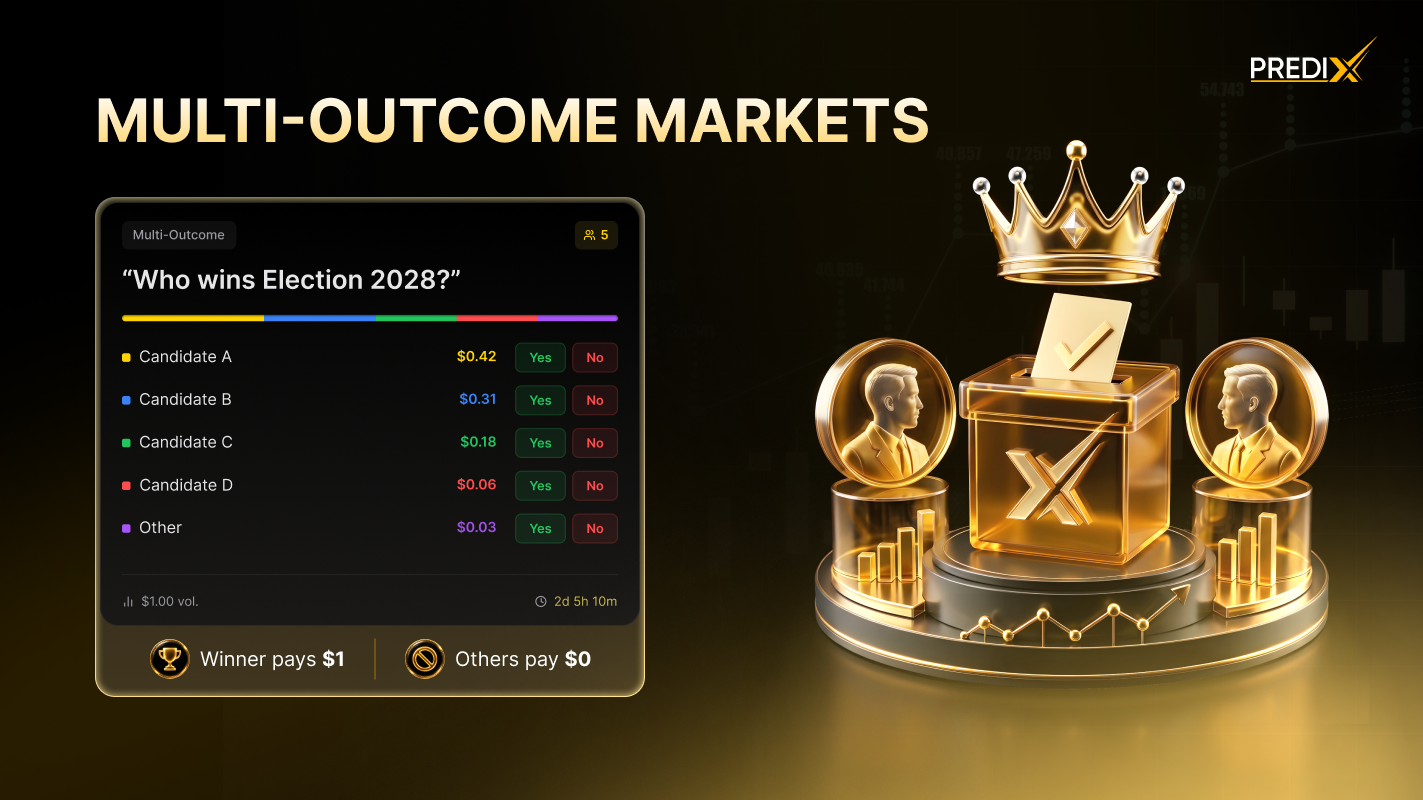
Not every question has a yes/no answer. “Who wins the 2026 FIFA World Cup?” has 32 possible answers, not 2. Multi-outcome markets let you trade events where exactly one out of many possible outcomes will be true.
PrediX implements multi-outcome markets as a group of binary markets - each outcome is its own YES/NO market, all linked under one MarketGroup. When the event resolves, the winning outcome’s YES pays $1, every other outcome’s NO pays $1, and the rest pay $0.
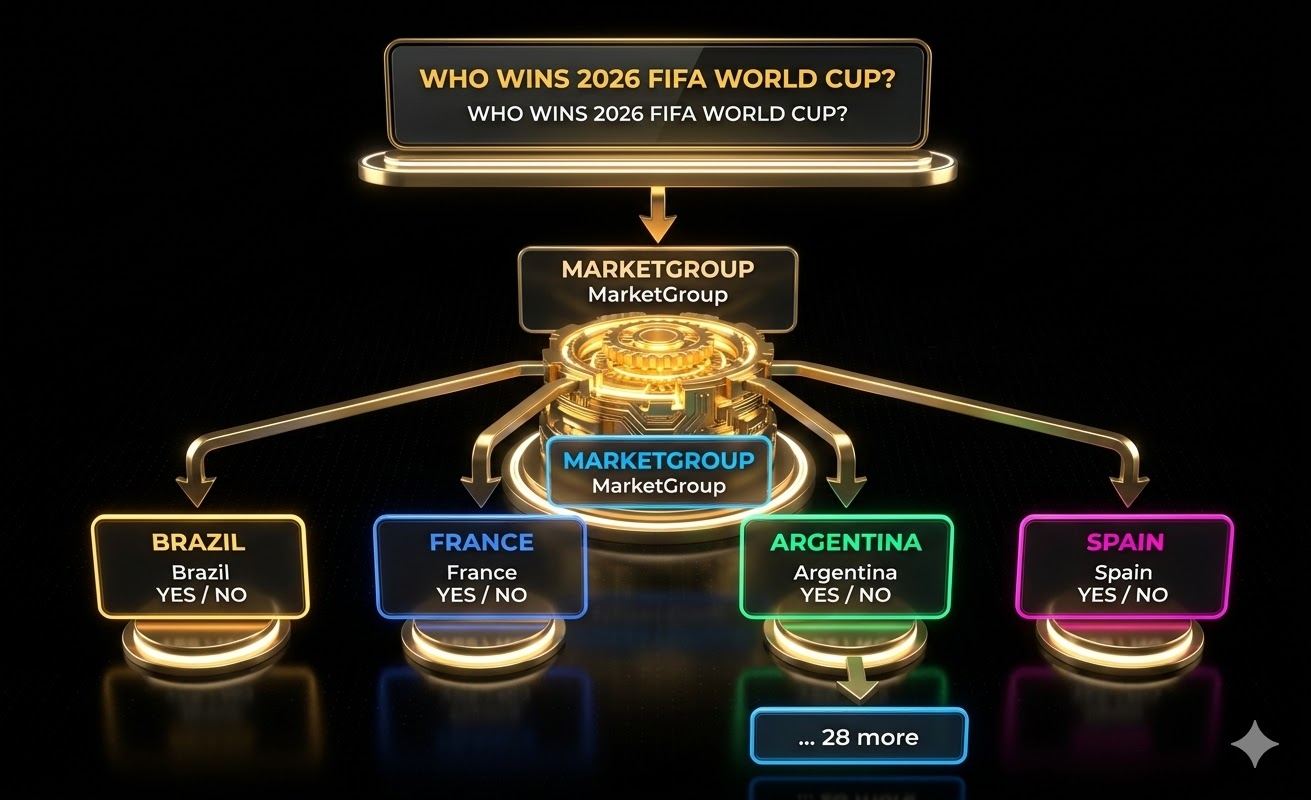
This design has a key property: only one outcome wins. If Brazil wins, Brazil-YES = $1, all other countries’ YES = $0. The MarketGroup contract enforces this - you can’t have two winners.
How It’s Different from Binary Markets
Section titled “How It’s Different from Binary Markets”| Feature | Binary Market | Multi-Outcome Market |
|---|---|---|
| Question shape | “Will X happen?” | “Which of N will happen?” |
| Outcomes | 2 (YES/NO) | N (one YES, rest NO) |
| Token pairs | 1 (YES + NO) | N (YES + NO per outcome) |
| AMM pools | 1 | N (one per outcome) |
| Resolution | Outcome = true or false |
Outcome = winning_index |
| Price sum constraint | YES + NO = $1 (per market) |
All YES prices ≈ $1 (total) |
The biggest mental shift: in a multi-outcome market, the sum of all YES prices ≈ $1 (it represents 100% probability distributed across outcomes).
Each outcome trades on its own Market Order, Limit Order, or via the AMM - exactly like binary markets.
GroupSplit & GroupMerge
Section titled “GroupSplit & GroupMerge”For multi-outcome markets, PrediX provides GroupSplit and GroupMerge - capital-efficient versions of Split & Merge for multiple outcomes at once.
GroupSplit
Section titled “GroupSplit”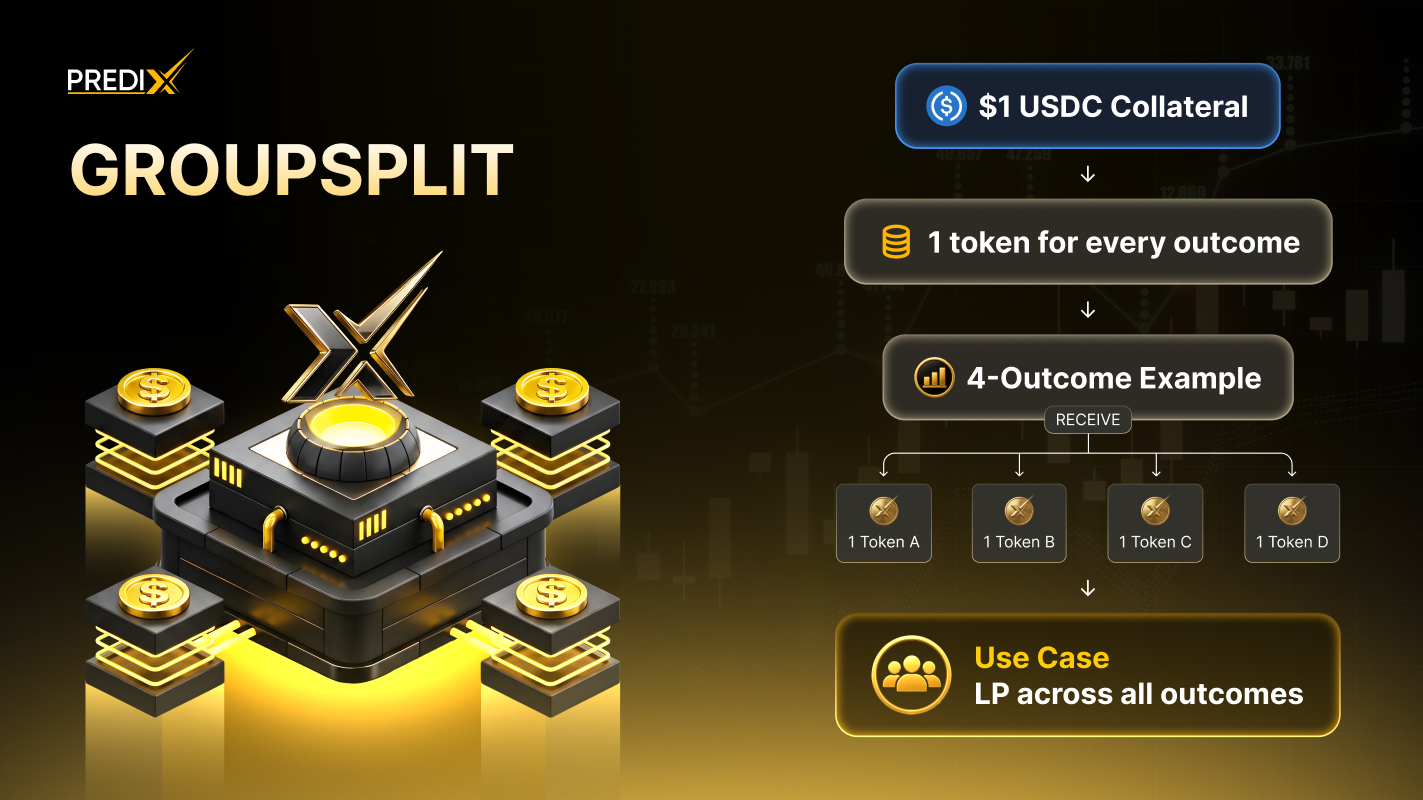
Deposit $1 USDC → receive 1 YES + 1 NO for every outcome in the group.
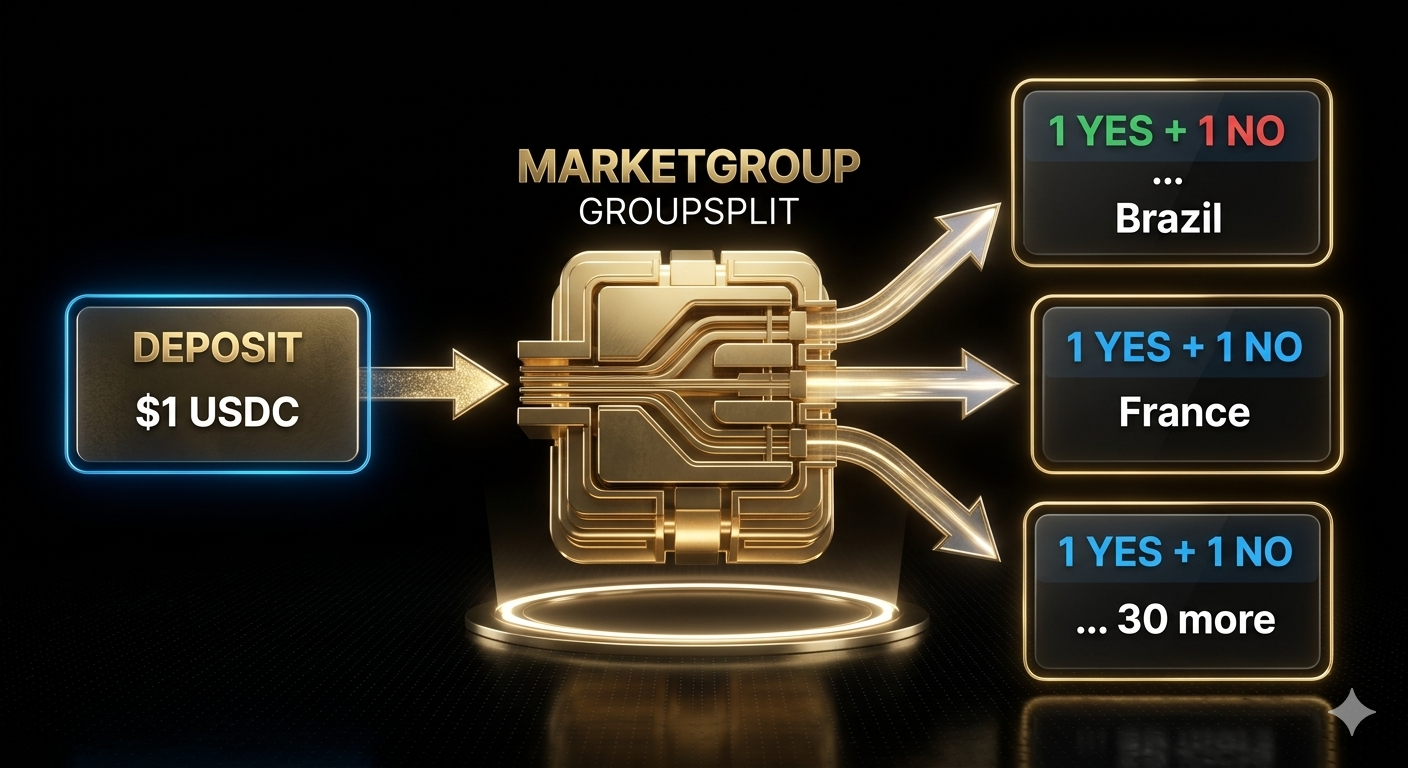
But wait - that doesn’t sum to $1. Why?
Because only the winning YES + 31 losing NO pay. The 31 losing YES = $0, and the 1 winning NO = $0. Net effect: you get exactly your $1 USDC back (minus the winning YES which is the one you’d actually “want”).
In practice, traders use GroupSplit to sell the YES tokens they don’t believe in at market prices and hold the YES they do believe in.
GroupMerge
Section titled “GroupMerge”Deposit 1 YES on every outcome → receive $1 USDC back.
If you hold equal amounts of YES across all outcomes (e.g., 1 Brazil-YES + 1 France-YES + ... + 1 Other-YES), you can burn them all and reclaim $1 USDC.
This is useful for:
- Exit liquidity: get out of a multi-outcome position without selling each leg
- Arbitrage cleanup: after exploiting price discrepancies, reset to USDC
- Capital recycling: redeem unused outcome positions back to cash
Arbitrage in Multi-Outcome Markets
Section titled “Arbitrage in Multi-Outcome Markets”Because all YES prices should sum to $1 (probabilities total to 100%), any deviation creates risk-free profit.
Scenario 1 - Sum < $1 (Undervalued)
If sum of all YES prices = $0.92:
- Buy
1 YES of every outcome→ costs$0.92 - At resolution, exactly one of those pays
$1 - Profit:
$0.08(less gas)
Scenario 2 - Sum > $1 (Overvalued)
If sum of all YES prices = $1.07:
- GroupSplit
$1 USDC→ get1 YES + 1 NOper outcome - Sell every YES at market =
$1.07 received - Profit:
$0.07(you keep the NO tokens, but they collectively are worth~$0after resolution since only 1 NO loses)
These arbitrages keep prices honest. Bots run them continuously, so manual opportunities last seconds.
Trading on Multi-Outcome Markets
Section titled “Trading on Multi-Outcome Markets”Trading each outcome works exactly like a binary market - same Market Order, Limit Order, Split, Merge operations:
| Action | What happens |
|---|---|
| Buy Brazil-YES | Buy YES shares on Brazil’s binary sub-market (its own orderbook + AMM pool) |
| Sell Brazil-NO | Sell NO shares on Brazil’s binary sub-market |
| Limit order on France-YES | Rest on France’s CLOB at your price |
| Split on a specific outcome | Convert USDC → YES + NO on one outcome (not all) |
| GroupSplit | Convert USDC → YES + NO on every outcome at once |
You can also place orders across multiple outcomes simultaneously - for example, “Buy Brazil-YES AND France-YES” as a diversified position.
Resolution Behavior
Section titled “Resolution Behavior”When a multi-outcome market resolves, the MarketGroup contract settles all sub-markets in a single transaction:
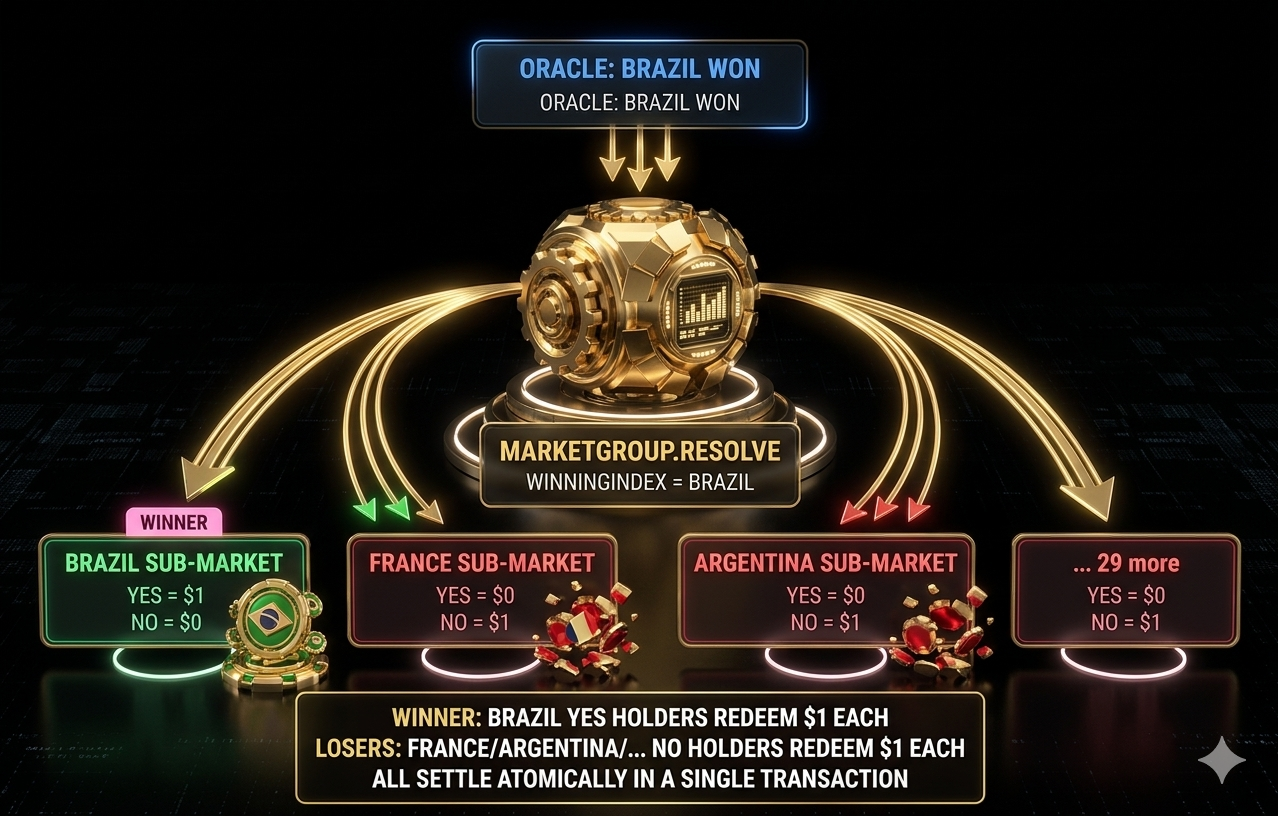
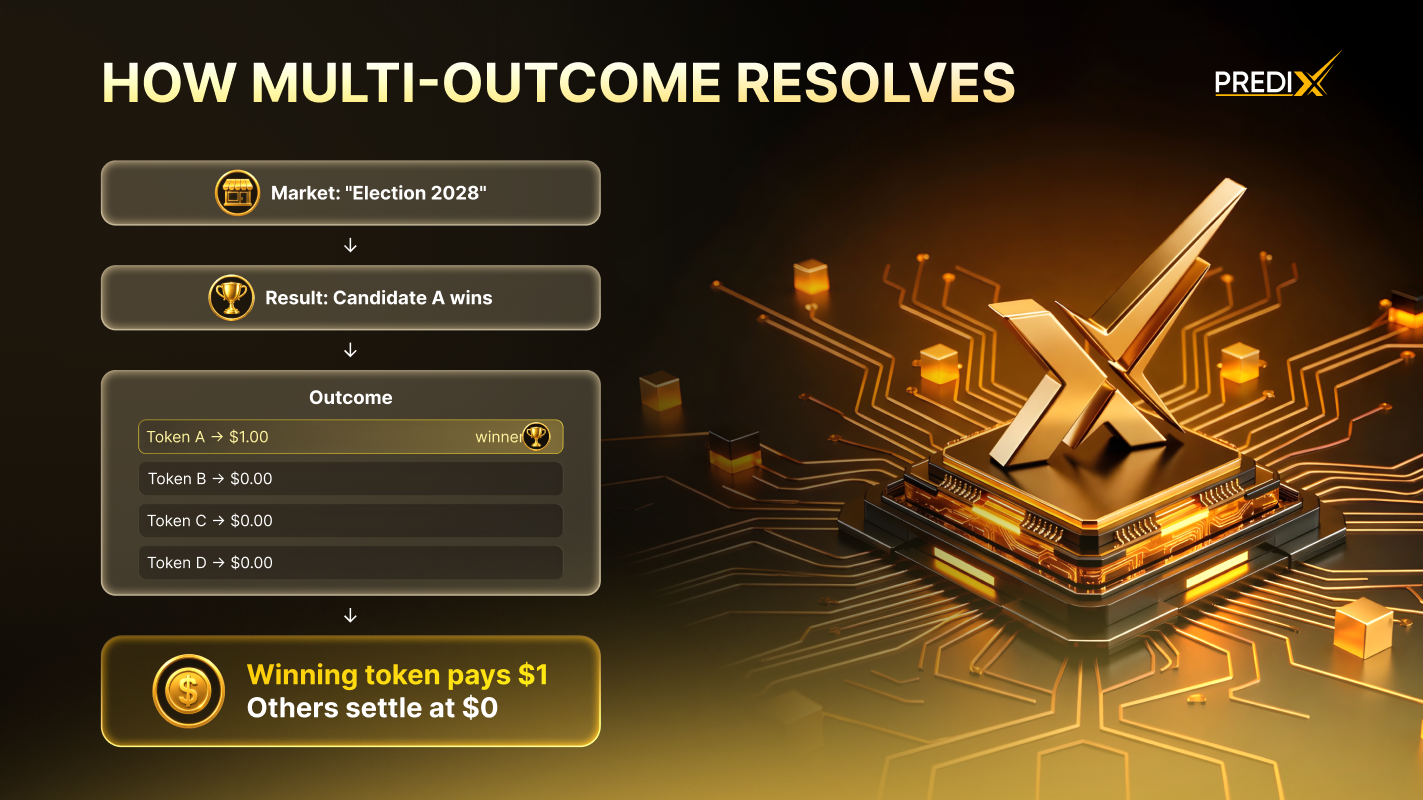
After resolution:
| Token type | Final value | Action |
|---|---|---|
| Winner’s YES (e.g., Brazil-YES) | $1 |
Redeem for USDC |
| Winner’s NO (e.g., Brazil-NO) | $0 |
Worthless; hide from watchlist |
| Loser’s YES (e.g., France-YES, Argentina-YES, …) | $0 |
Worthless |
| Loser’s NO (e.g., France-NO, Argentina-NO, …) | $1 |
Redeem for USDC |
Use Cases
Section titled “Use Cases”1. Concentrated bet on a favorite
You think Brazil is significantly undervalued at $0.22. Real probability is ~35% in your view.
Strategy: Buy $1,000 of Brazil-YES at $0.22 = 4,545 shares.
- If Brazil wins: receive
$4,545(4.5× return) - If Brazil loses: lose
$1,000
Expected value = 0.35 × $4,545 - 0.65 × $1,000 = $1,591 - $650 = +$941
This is a high-conviction directional bet.
2. Diversified portfolio across favorites
You think the top 4 favorites are all reasonable but you can’t pick one. Spread $1,000 across them.
$250Brazil-YES at$0.22→1,136 shares→ pays$1,136if Brazil wins$250France-YES at$0.18→1,389 shares→ pays$1,389if France wins$250Argentina-YES at$0.16→1,562 shares→ pays$1,562if Argentina wins$250England-YES at$0.12→2,083 shares→ pays$2,083if England wins
If any one of them wins, you profit. Combined probability ~68%. Lower variance, lower upside.
3. Fade the longshot
You think Germany has zero chance at $0.08. Sell Germany-YES (or equivalently, buy Germany-NO).
Buy $1,000 of Germany-NO at $0.92 → 1,087 shares.
- If Germany loses (or doesn’t win): receive
$1,087(+$87= +8.7%) - If Germany wins: lose
$1,000
Low-upside high-conviction fade. Effective when the longshot is overpriced.
4. Group arbitrage
After scanning all outcomes, you notice the sum of all YES prices is $0.96 (instead of $1).
Strategy: Buy $1 worth of each outcome’s YES (total cost $0.96 for the group).
At resolution, exactly one of those YES tokens pays $1. Risk-free profit $0.04 per dollar of group bought (less gas).
Note: this requires buying many small positions — only profitable at significant size or with low gas (Unichain).
5. Hedging an existing concentrated bet
You bought $1,000 of Brazil-YES. As tournament progresses, Brazil narrowly survives Round of 16 — you want to lock in some profit without selling Brazil-YES (price has moved to $0.45).
Strategy: GroupSplit $300 → get YES + NO on every outcome.
- Sell the 31 YES tokens you don’t want (Brazil-YES you keep)
- Net: you’ve reduced exposure while keeping upside on Brazil
Common Multi-Outcome Market Types
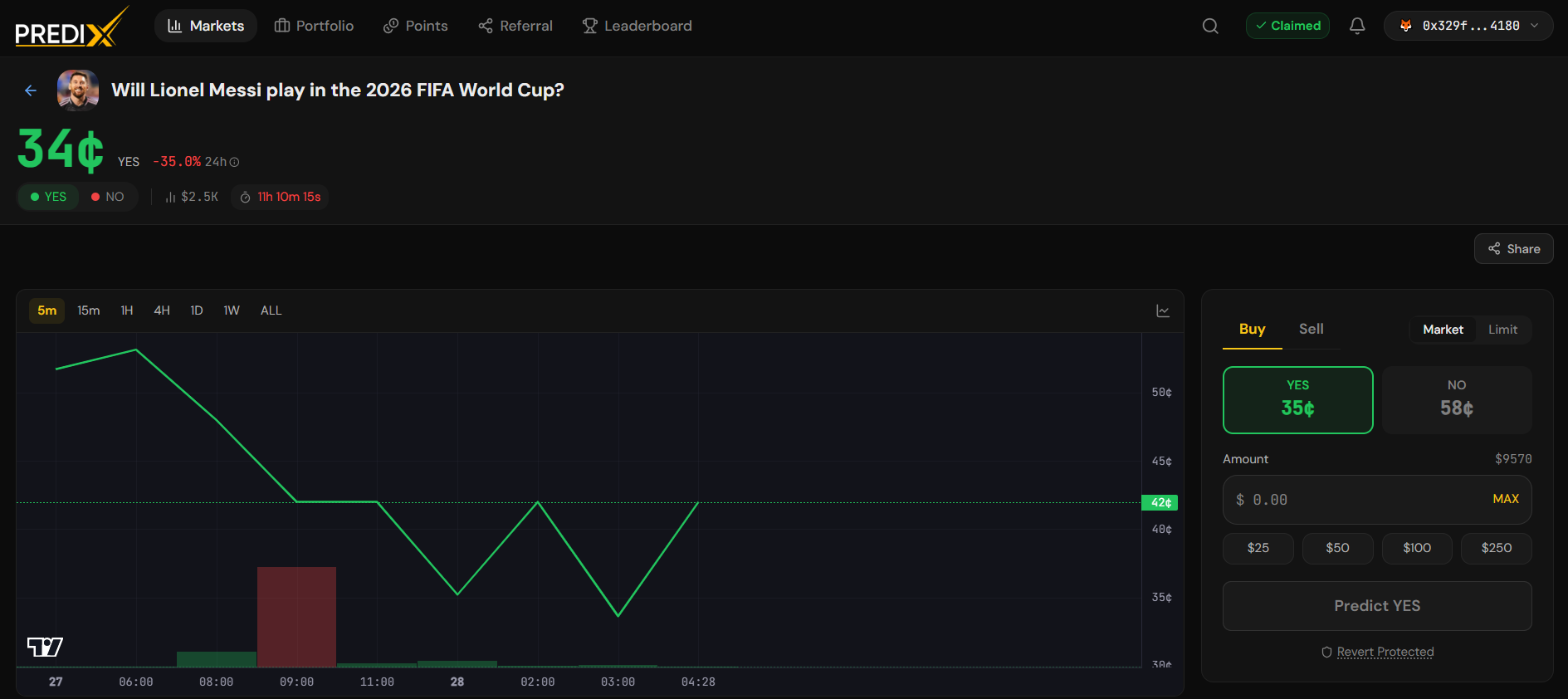
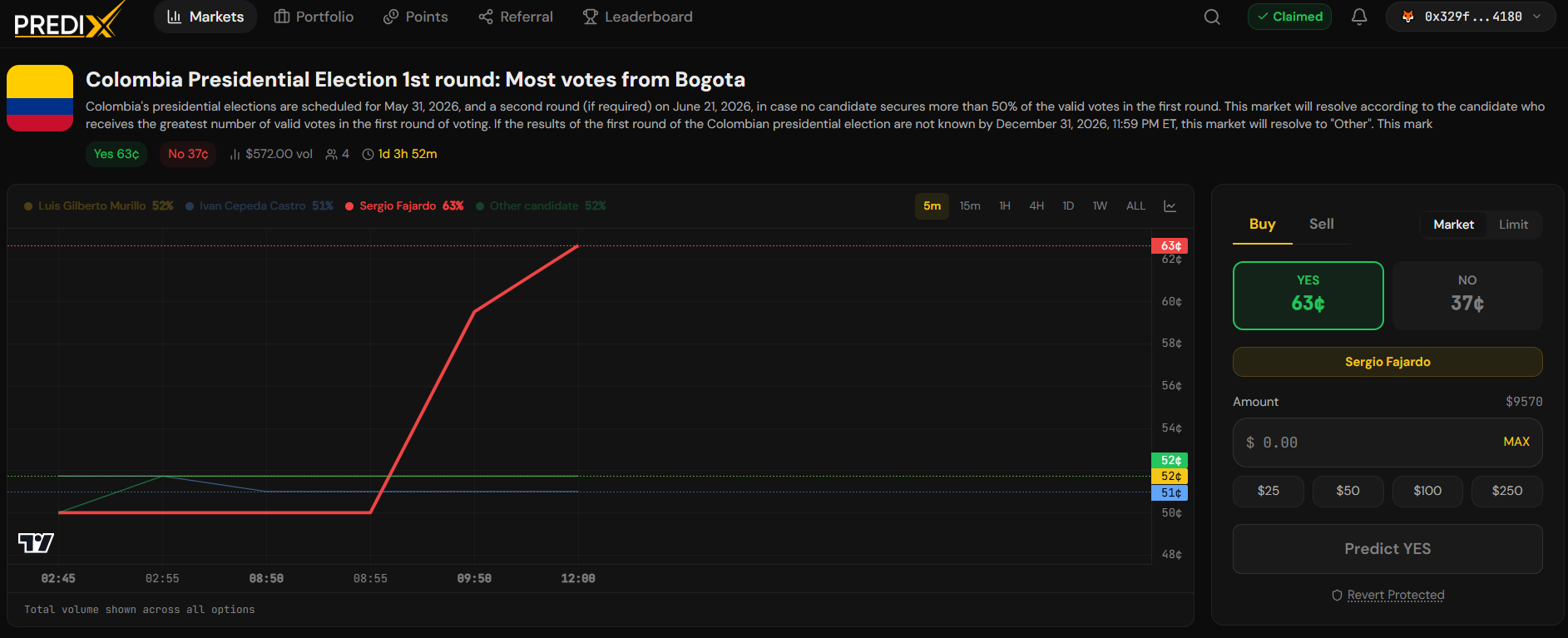
Section titled “Common Multi-Outcome Market Types”PrediX supports several multi-outcome formats, each follows the same MarketGroup pattern under the hood.:
| Cover image | ||
|---|---|---|
| Tournament winner | FIFA World Cup, NBA Finals, Wimbledon,... | 22.png |
| Multi outcome | Colombia Presidential Election 1st round: Most votes from Bogota,... | 23.png |
| Multi-choice | "Which K-pop group has #1 album in Q4?" | 24.png |
How PrediX Differs from Polymarket’s NegRisk
Section titled “How PrediX Differs from Polymarket’s NegRisk”Polymarket implements multi-outcome markets using their NegRisk adapter on top of Conditional Token Framework (ERC-1155). PrediX uses MarketGroup with pure ERC-20 outcome tokens.
| Feature | Polymarket NegRisk | PrediX MarketGroup |
|---|---|---|
| Token standard | ERC-1155 | ERC-20 |
| Native Uniswap v4 trading | ❌ Requires wrapper | ✅ Direct |
| DeFi composability | ❌ Limited (ERC-1155 support) | ✅ Full (collateral, vaults, indices) |
| Liquidity per outcome | Shared via NegRisk AMM | Independent (each outcome has its own pool) |
| Multi-outcome resolution | Atomic via CTF | Atomic via MarketGroup |
PrediX outcome tokens are fully composable - you can use Brazil-YES as collateral on Aave, wrap it in an index, or trade it on any DEX that supports ERC-20.