Router integration
The Router is the single entry point for all swaps. Let your users trade through your app by calling the Router contract.
Router address:
- Beta (Unichain mainnet, live):
0x39043ba36CF86590668200fb4Be094b9259B917E - Production (TBA, after launch)
Full address list: Contract addresses.
Core function:
function buyYes(    uint256 marketId,    uint256 usdcIn,    uint256 minYesOut,    address recipient,    uint256 maxFills,    uint256 deadline) external returns (    uint256 yesOut,    uint256 clobFilled,    uint256 ammFilled);
function sellYes(    uint256 marketId,    uint256 yesIn,    uint256 minUsdcOut,    address recipient,    uint256 maxFills,    uint256 deadline) external returns (    uint256 usdcOut,    uint256 clobFilled,    uint256 ammFilled);
// buyNo, sellNo are symmetric
Quote before swap
Section titled “Quote before swap”function quoteBuyYes( uint256 marketId, uint256 usdcIn, uint256 maxFills) external returns ( uint256 expectedYesOut, uint256 clobPortion, uint256 ammPortion);Non-view function (modifies transient state). Use simulateContract (not readContract) to call it off-chain. Use it to show a preview to users before they sign.
Viem / TypeScript example
Section titled “Viem / TypeScript example”import { createPublicClient, createWalletClient, custom, http, parseUnits } from 'viem';import { unichain } from 'viem/chains'; // current beta on mainnet// Define Router ABI inline or import from source
const publicClient = createPublicClient({ chain: unichain, transport: http('https://mainnet.unichain.org'),});
const walletClient = createWalletClient({ chain: unichain, transport: custom(window.ethereum),});
// Beta Router (production TBA)const ROUTER = '0x39043ba36CF86590668200fb4Be094b9259B917E';const marketId = 1n; // uint256
// 1. Quote (non-view, use simulateContract)const { result: [expectedOut, clobPortion, ammPortion] } = await publicClient.simulateContract({ address: ROUTER, abi: routerAbi, functionName: 'quoteBuyYes', args: [marketId, parseUnits('100', 6), 10n], // 100 USDC, maxFills=10});
console.log(`Expected: ${expectedOut} YES, CLOB: ${clobPortion}, AMM: ${ammPortion}`);
// 2. Compute minOut with 0.5% slippageconst minOut = (expectedOut * 995n) / 1000n;
// 3. Execute (user signs tx)const [account] = await walletClient.getAddresses();const hash = await walletClient.writeContract({ address: ROUTER, abi: routerAbi, functionName: 'buyYes', args: [ marketId, parseUnits('100', 6), // usdcIn minOut, // minYesOut account, // recipient 10n, // maxFills (CLOB depth) BigInt(Math.floor(Date.now()/1000) + 300), // deadline 5min ], account,});
const receipt = await publicClient.waitForTransactionReceipt({ hash });console.log('Trade complete:', receipt.transactionHash);Approve USDC
Section titled “Approve USDC”The Router needs to pull USDC from the user via Permit2 (gasless approve).
Option 1: ERC-20 approve + Permit2 pull
Section titled “Option 1: ERC-20 approve + Permit2 pull”// 1. User approves USDC for Permit2 (one-time per token)await walletClient.writeContract({ address: USDC, abi: erc20Abi, functionName: 'approve', args: [PERMIT2, MAX_UINT256],});
// 2. Permit2 sign off-chain, included in Router call// See @uniswap/permit2-sdk docs for detailed encodingOption 2: Direct approve to Router (less recommended - not gasless)
Section titled “Option 2: Direct approve to Router (less recommended - not gasless)”await walletClient.writeContract({ address: USDC, abi: erc20Abi, functionName: 'approve', args: [ROUTER, MAX_UINT256],});Permit2 signed approve (gas reduction)
Section titled “Permit2 signed approve (gas reduction)”Instead of 2 txs (approve + swap), the user signs a Permit2 message offline and includes the signature in a single swap tx:
import { SignatureTransfer } from '@uniswap/permit2-sdk';
const permit = SignatureTransfer.createPermit(  USDC, amount, spender: ROUTER, deadline);const signature = await walletClient.signTypedData(permit);
await walletClient.writeContract({  address: ROUTER,  abi: routerAbi,  functionName: 'buyYesWithPermit',  args: [marketId, usdcIn, minOut, recipient, maxFills, deadline, permit, signature],});
The Router requires exact-amount permits: permitSingle.details.amount must equal usdcIn, and permitSingle.spender must equal the Router address. A mismatch reverts with InvalidPermitAmount / InvalidPermitSpender. Sign a fresh per-trade permit for each call.
Permit2 details: docs.uniswap.org/contracts/permit2.
Encode marketId
Section titled “Encode marketId”Market ID is a uint256. The Indexer, BE, and FE use decimal strings for URLs and wire format.
// Decimal string -> BigInt (for contract calls)const marketId = BigInt(decimalString);
// Reverseconst decimal = marketId.toString();
Handle errors
Section titled “Handle errors”The Router reverts with custom errors. Decode using the 4-byte selector:
error InsufficientOutput(uint256 actual, uint256 minimum);error DeadlineExpired(uint256 deadline, uint256 currentTime);error MarketModulePaused();error MarketExpired();error MarketResolved();error MarketInRefundMode();error MarketNotFound();error InvalidRecipient();error InsufficientLiquidity(); // hybrid CLOB+AMM cannot cover the tradeerror ExactInUnfilled(uint256 amountIn); // neither CLOB nor AMM filled any portionerror InvalidPermitAmount(); // Permit2 amount != usdcInerror InvalidPermitSpender(); // Permit2 spender != Routererror FinalizeBalanceNonZero(); // internal bug, report if encounteredIn viem:
try { await walletClient.writeContract({ ... });} catch (err: any) { if (err.cause?.data?.errorName === 'InsufficientOutput') { // handle slippage }}Emitted events
Section titled “Emitted events”After a swap, the Router emits:
event Trade(    uint256 indexed marketId,    address indexed trader,    address indexed recipient,    TradeType tradeType,    // 0=BUY_YES, 1=SELL_YES, 2=BUY_NO, 3=SELL_NO    uint256 amountIn,    uint256 amountOut,    uint256 clobFilled,    uint256 ammFilled);
event ClobSkipped(    uint256 indexed marketId,    address indexed recipient,    bytes4 reason           // 4-byte selector of the CLOB revert (or 0x0));
Trade is the canonical source for the indexer. Listen to it to update your UI after tx confirmation. ClobSkipped fires when the CLOB leg reverted and the trade fell back to the AMM - useful as an observability signal in your dashboards.
Batch with Smart Account
Section titled “Batch with Smart Account”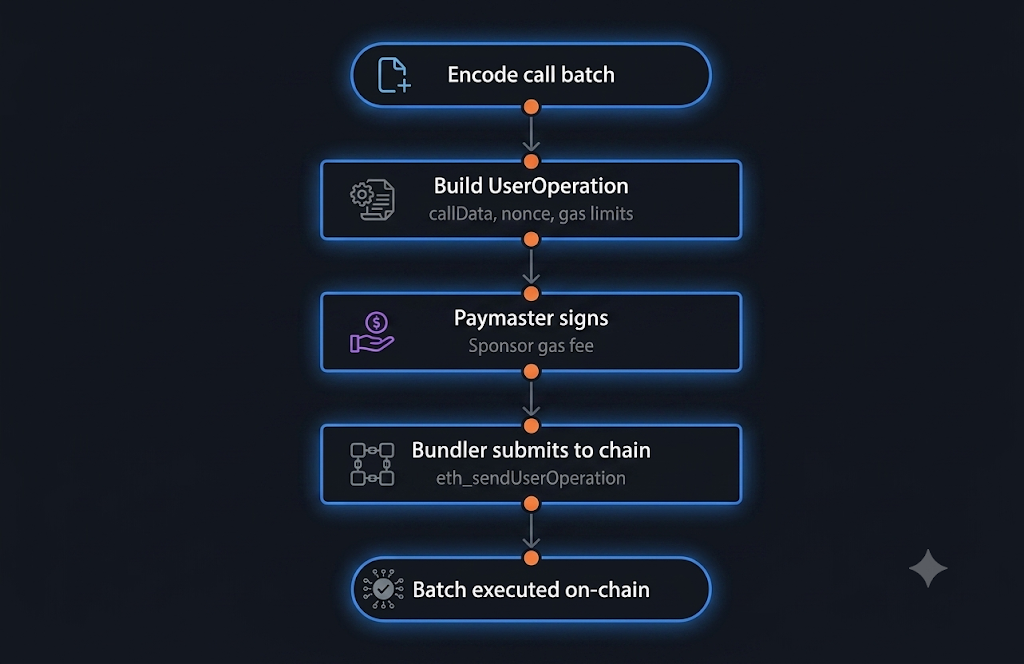
AA UserOp batch
import { createKernelClient } from '@zerodev/sdk';
const kernelClient = createKernelClient({...});
const calls = [  {    to: USDC,    data: encodeFunctionData({      abi: erc20Abi, functionName: 'approve', args: [ROUTER, MAX]    }),  },  {    to: ROUTER,    data: encodeFunctionData({      abi: routerAbi, functionName: 'buyYes', args: [...]    }),  },];
const userOpHash = await kernelClient.sendUserOperation({  callData: await kernelClient.encodeCalls(calls),});
const txHash = await kernelClient.waitForUserOperationReceipt({  hash: userOpHash,});
Gas is paymaster-sponsored if the user has an active SIWE session via the PrediX app.
AMM-only or CLOB-only
Section titled “AMM-only or CLOB-only”The Router always uses hybrid routing. If you want:
- AMM-only (skip CLOB): call Uniswap v4’s UniversalRouter directly.
- CLOB-only (skip AMM): call
PrediXExchange.fillMarketOrderorplaceOrder.
The default recommendation is to use PrediXRouter - it optimizes price across both sources.
Test on local fork
Section titled “Test on local fork”# Anvil fork Unichain mainnet (current beta runs here)anvil --fork-url https://mainnet.unichain.org
# Deploy test contract or call directlyforge script test/Integration.s.sol --fork-url http://localhost:8545Common patterns
Section titled “Common patterns”Auto-slippage
Section titled “Auto-slippage”async function smartSlippage(usdcIn: bigint): Promise<bigint> { // Try 0.5% first let slippage = 50n; // bps
while (slippage <= 500n) { try { const [expected] = await quoteBuyYes(marketId, usdcIn); const minOut = (expected * (10000n - slippage)) / 10000n; return minOut; } catch (err) { slippage += 50n; } } throw new Error('Liquidity too thin');}Multi-market batch
Section titled “Multi-market batch”const trades = [ { marketId: 'm1', usdcIn: 100n }, { marketId: 'm2', usdcIn: 50n },];
const calls = trades.map(t => ({ to: ROUTER, data: encodeFunctionData({ abi: routerAbi, functionName: 'buyYes', args: [t.marketId, t.usdcIn, ...], }),}));
await kernelClient.sendUserOperation({ callData: await kernelClient.encodeCalls(calls),});1 UserOp executes N trades atomically.