CLOB + AMM hybrid
PrediX combines 2 liquidity mechanisms: an on-chain order book (CLOB) + a Uniswap v4 pool (AMM). For every trade the Router prices both venues and routes for best execution within the same transaction.
Why Hybrid
Section titled “Why Hybrid”| Model | CLOB (Polymarket) | AMM (Uniswap) | Hybrid (PrediX) |
|---|---|---|---|
| Small trades | OK but wide slippage if few makers | Smooth, low slippage | Smooth + price improvement when makers are present |
| Large trades | Depends on maker depth | Slippage increases with size | Price both venues, fill CLOB only where it beats the AMM, route the remainder to AMM |
| Maker incentive | Limit order (no fee) | Only LPs earn fees | Both - makers place orders, LPs provide liquidity |
| Fair pricing | Makers set their own | AMM curve | AMM-effective = floor, CLOB = price improvement on top |
| MEV protection | Order book harder to frontrun | Pool vulnerable to sandwich | Hook anti-sandwich + identity commit |
Router - Single Entry Point
Section titled “Router - Single Entry Point”The Router is stateless - the invariant balanceOf(router) == 0 is enforced on-chain after every public call (USDC, YES and NO are each refunded to the caller and asserted to zero). No custody, no stuck funds.
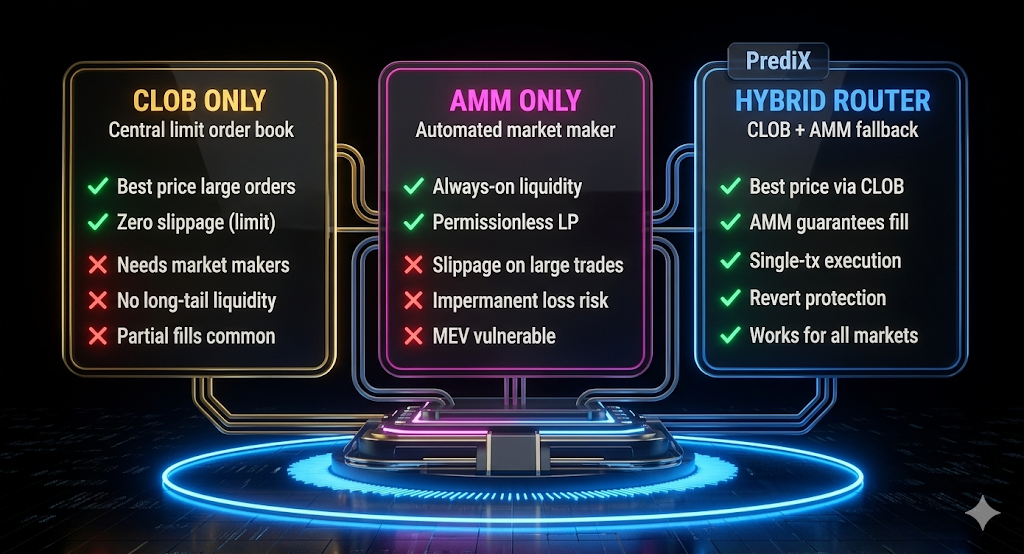
Comparison of CLOB vs AMM vs Hybrid PrediX
How the Execution Router Works
Section titled “How the Execution Router Works”For every trade the Router prices both venues and routes for best execution - it does not blindly drain the order book first:
- Quote the AMM. The Router computes the AMM effective price (size-adjusted and fee-included) for your trade size - not the spot price.
- Let the CLOB compete. The CLOB leg is capped at that AMM-effective price, so the order book fills only the portion priced as good as or better than the AMM. The Router converges on the optimal split: the size where the marginal CLOB order equals the AMM-effective price for the leftover.
- Execute. One CLOB fill (bounded by the cap) + one AMM swap for the remainder. If the AMM is cheaper across your whole size, the CLOB fills ~nothing and the AMM takes everything; if the CLOB is better, it fills more. Either way you get the best blended price.
CLOB - On-Chain Order Book
Section titled “CLOB - On-Chain Order Book”Contract: PrediXExchange.
- Tick size: 99 price levels at $0.01, $0.02, …, $0.99. Stored on compressed bitmaps.
- Limit order: User selects side (BUY_YES / SELL_YES / BUY_NO / SELL_NO), price, and amount. Token or USDC deposit is locked until filled or cancelled.
- Makers place limit orders and wait for fills. Takers execute against them as market orders.
3 CLOB Match Types
Section titled “3 CLOB Match Types”All 3 satisfy: no one is disadvantaged - each side accepts their own price.
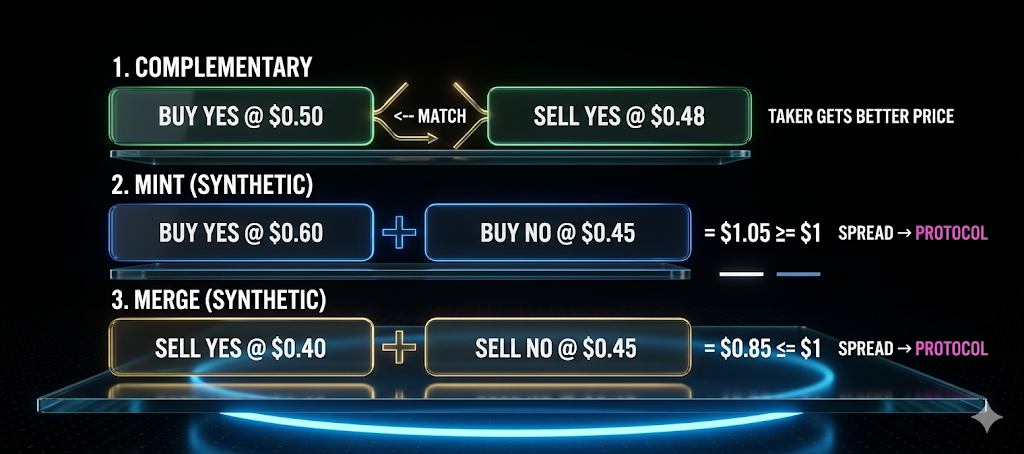
3 CLOB match types PrediX
- Complementary: BUY_YES ↔ SELL_YES in the same market. Most common.
- Mint (synthetic): BUY_YES + BUY_NO ≥ $1. The Diamond mints a pair, delivering YES to the YES buyer and NO to the NO buyer. Any surplus (their combined price above $1) is refunded to the taker as price improvement - the protocol charges no per-trade fee.
- Merge (synthetic): SELL_YES + SELL_NO ≤ $1. The Diamond burns a pair, returning USDC to both sellers. Surplus is zero by construction - no per-trade fee.
AMM - Uniswap v4 Pool
Section titled “AMM - Uniswap v4 Pool”Each market has exactly one v4 pool: YES-USDC. There is no NO-USDC pool - NO is priced as 1 − YES and traded synthetically through the YES pool: buying NO mints a YES/NO pair and sells the YES leg into the pool; selling NO buys YES from the pool and merges it with your NO back into collateral. (Anyone could permissionlessly deploy a separate NO-USDC pool on Uniswap, but it cannot register with the PrediX Hook and the Router never routes to it.)
PrediX Hook plugs into v4:
| Callback | Function |
|---|---|
beforeSwap |
Verify anti-sandwich identity (the Router must commit identity first; the Hook checks it via transient storage, EIP-1153) |
beforeAddLiquidity |
Block adding LP when the market is resolved / in refund mode / past endTime, and bound liquidity to the [0,1] YES-price band |
beforeRemoveLiquidity |
Verify the pool is registered (LPs can always exit) |
beforeDonate |
Block donations after endTime (prevent brute-force payout attacks) |
The Hook does not hold user funds long-term. LPs hold standard Uniswap v4 liquidity positions (via the PositionManager).
When Does the Router Prefer CLOB Over AMM
Section titled “When Does the Router Prefer CLOB Over AMM”The Router prices the AMM first, then lets the CLOB compete against that price:
- It quotes the AMM effective price (size-adjusted) - not spot.
- The CLOB leg is capped at that price, so it fills only orders as good as or better than the AMM; the remainder routes to the AMM.
- It converges on the optimal split - the size where the marginal CLOB order equals the AMM-effective price for the leftover.
- No active pool liquidity -> routing is 100% CLOB. If the CLOB reverts (insufficient token match, price deviation) -> the Router skips it, emits a
ClobSkipped(reason)event, and falls back entirely to the AMM.
Users don’t need to worry - the Router always returns the best blended price within the same tx.
MEV Protection
Section titled “MEV Protection”PrediX Hook implements identity commit to prevent sandwich attacks:
MEV bots cannot frontrun + backrun your trade within the same block - the Hook reverts if the committed identity doesn’t match. Opposite-direction swaps from the same identity in one block are rejected; same-direction splits are allowed.
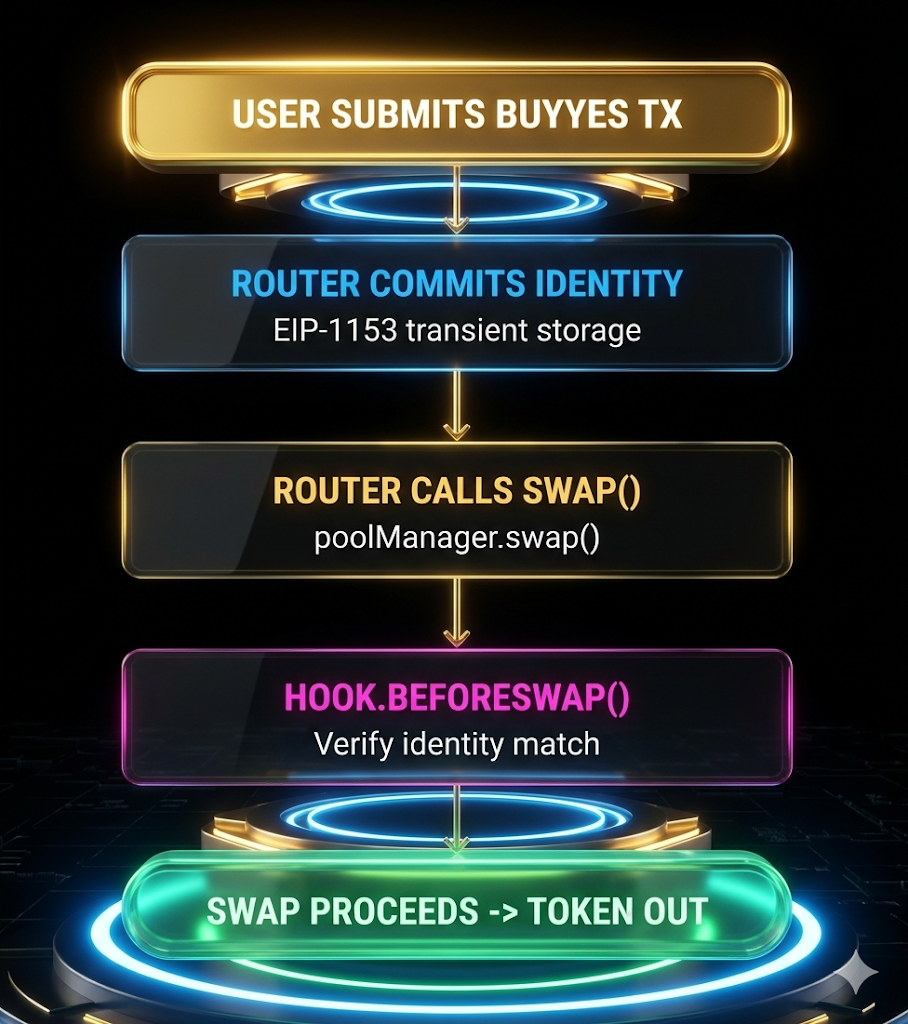
Anti-sandwich MEV PrediX