Economic Architecture
Core Value Accrual
Section titled “Core Value Accrual”PrediX is designed with a multi-layered revenue architecture that combines trading fees, liquidity monetization, yield optimization, and financial infrastructure services.
All on-chain revenue generated by the ecosystem is routed back into the PRX value accrual system, reinforcing long-term alignment between protocol growth, liquidity depth, and token utility.
The protocol economy is structured around three core objectives:
- Sustainable protocol revenue generation
- Deep liquidity and market efficiency
- Direct value capture for PRX holders and stakers
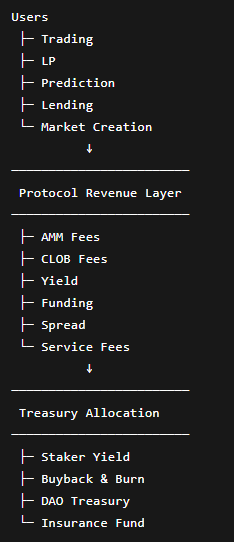
Revenue Architecture
Section titled “Revenue Architecture”1. AMM Swap Fee
Section titled “1. AMM Swap Fee”Dynamic swap fees are applied to trades executed through the Uniswap v4 AMM infrastructure.
| Time to Expiry | Dynamic Fee |
|---|---|
| 7+ days | 0.5% |
| 3–7 days | 1% |
| 1–3 days | 2% |
| Under 24 hours | 5% |
Design Objectives
- Protect LPs against volatility spikes
- Reduce toxic flow near settlement
- Compensate LPs for late-stage information asymmetry
- Preserve long-term liquidity sustainability
This mechanism improves LP profitability while stabilizing liquidity during high-risk settlement periods.
2. CLOB Taker Fee
Section titled “2. CLOB Taker Fee”The protocol charges taker fees on trades executed through the Central Limit Order Book (CLOB).
Fee Formula: Fee=C×r×p(1−p)\mathrm{Fee}=C \times r \times p(1-p)Fee=C×r×p(1−p)
Where:
- CCC = position size
- rrr = market fee rate
- ppp = implied probability price
&#xNAN;*Example: Sports markets apply a standard fee rate of 2.0%.
The pricing structure naturally reduces fees near probability extremes (0 or 1) while maximizing efficiency around highly contested markets.
3. Spread Revenue
Section titled “3. Spread Revenue”PrediX operates a treasury-managed liquidity layer that captures spread revenue from market-making activities.
This model is conceptually similar to the liquidity framework pioneered by GMX through GLP.
Revenue Sources
- Bid-ask spread capture
- Inventory rebalancing
- Volatility-driven pricing inefficiencies
By internalizing part of the liquidity stack, the protocol creates an additional non-dilutive revenue stream.
4. Collateral Yield
Section titled “4. Collateral Yield”Idle collateral assets such as USDC are deployed into low-risk lending strategies to improve capital efficiency.
Example Integrations
- Aave
Target Yield Range
- 3% – 5% APY
This yield becomes part of the protocol’s recurring treasury income while maintaining high liquidity availability.
5. Market Creation Fee
Section titled “5. Market Creation Fee”Users creating new prediction markets pay a deployment fee.
Base Fee: 10 – 50 USDC
→ Starting from Phase 2, market creators must additionally bond PRX tokens.
PRX Bonding Objectives
- Sybil resistance
- Market quality incentives
- Long-term token utility
6. Perpetual Prediction Markets
Section titled “6. Perpetual Prediction Markets”The protocol supports no-expiry prediction markets with perpetual trading mechanics.
Revenue Sources
- Funding rate payments
- Perpetual position rebalancing fees
This creates continuous fee generation independent of fixed settlement cycles.
7. Liquidity Manager
Section titled “7. Liquidity Manager”PrediX monetizes advanced liquidity infrastructure through a dedicated Liquidity Manager layer.
Revenue Sources
- Percentage share of LP fees
- Premium analytics tools
Analytics Features
- P&L dashboard
- Liquidity heatmaps
- LP performance analytics
This layer primarily targets professional traders, LPs, and market makers.
8. BNPL (Buy Now Pay Later)
Section titled “8. BNPL (Buy Now Pay Later)”The protocol enables leveraged participation through installment-based market access.
Revenue Sources
- Installment fees
- Interest spread income
Mechanism
- Installment fees
- Interest spread income
This model expands accessibility while maintaining protocol solvency.
9. Crowdfunded Market Creation
Section titled “9. Crowdfunded Market Creation”Communities can collectively fund the creation of new markets.
Once funding targets are reached:
- Markets are automatically deployed
- The protocol charges a launch fee
- A percentage of LP revenue is retained throughout the market lifecycle
This creates scalable permissionless market expansion.
10. Group Buying
Section titled “10. Group Buying”Users can participate in coordinated group positioning.
Benefits
- Users receive execution discounts of 2% – 5%
- The protocol still charges fees based on aggregate gross volume
This structure improves user acquisition while preserving positive net margins.
11. Lossless Lottery
Section titled “11. Lossless Lottery”PrediX offers yield-powered lottery mechanisms where principal remains protected.
Revenue Sources
- Management fees on generated yield
- Yield spread before jackpot distribution
This model combines gamification with capital preservation.
Fee & Revenue Routing
Section titled “Fee & Revenue Routing”All protocol revenue generated on-chain is systematically routed back into the PRX ecosystem.
1. Staker Yield
Section titled “1. Staker Yield”A portion of protocol revenue is distributed in USDC to users who stake PRX tokens.
Objectives
- Reward long-term participation
- Reduce circulating supply
- Strengthen token retention
2. Buyback & Burn
Section titled “2. Buyback & Burn”Part of treasury revenue is used to repurchase PRX tokens from the open market and permanently burn them.
Objectives
- Create deflationary pressure
- Align protocol growth with token scarcity
- Improve long-term value capture
3. Treasury & Insurance Fund
Section titled “3. Treasury & Insurance Fund”Revenue allocation also supports the DAO Treasury and Insurance Fund.
DAO Treasury
Used for:
- Ecosystem growth
- Grants
- Operations
- Strategic expansion
Insurance Fund
Used to:
- Cover unexpected protocol risks
- Reduce insolvency events
- Improve user confidence during extreme volatility
Long-Term Economic Vision
Section titled “Long-Term Economic Vision”PrediX is designed to evolve beyond a traditional prediction market into a full-stack on-chain financial coordination layer.
By combining:
- Trading infrastructure
- Liquidity monetization
- Yield generation
- Market creation primitives
- Treasury-owned liquidity